

Probe CPITN-C / UNC-15, Double Ended, Silicone Handle
Couldn't load pickup availability
| SKU | 111237DS |
| Brand | INSTRUDENTAL |
| Type | Diagnostic |
| Category | Diagnostic |
| Tags | 1112-37-DSSilicone Handle |
| Stock | ✓ In Stock |
DETAILS AND CARE
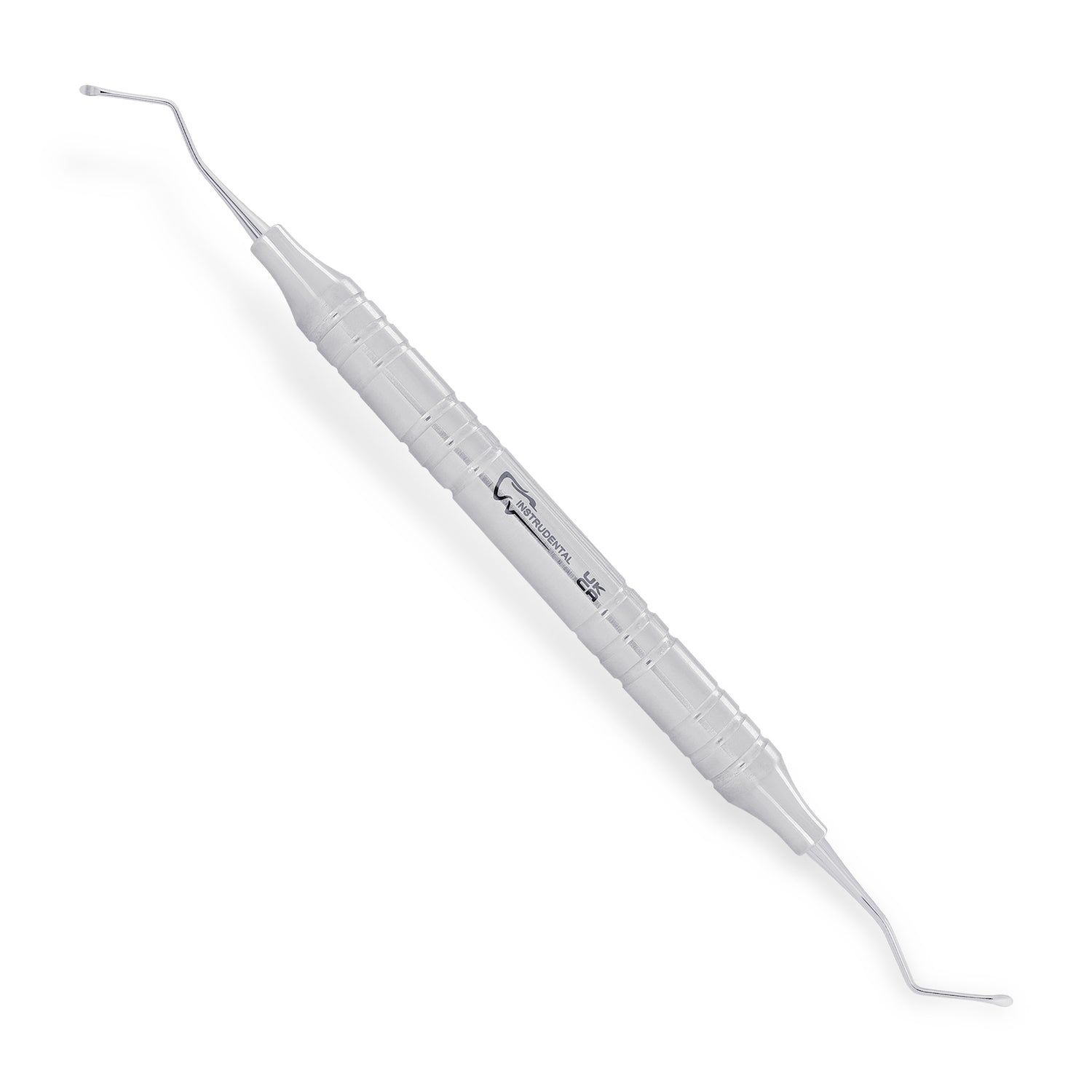
The CPITN-C / UNC-15 is a double-ended periodontal probe with a CPITN-C (WHO-type) screening probe on one end and a UNC-15 charting probe on the other, so you can carry out a Basic Periodontal Examination (BPE) and then chart pocket depths without changing instruments. The CPITN-C end has a small ball tip with a black band from 3.5 to 5.5mm and a second black band from 8.5 to 11.5mm. The UNC-15 end has a slim, straight tip marked at every millimetre up to 15mm, with black bands at 4 to 5, 9 to 10 and 14 to 15mm. Both ends sit on angled, double-bend shanks set into a wide, lightweight, textured silicone handle.
- CPITN-C end with a ball tip and black bands at 3.5 to 5.5mm and 8.5 to 11.5mm for BPE screening
- UNC-15 end marked at every millimetre to 15mm, with black bands at 4 to 5, 9 to 10 and 14 to 15mm, for full periodontal charting
- Wide, lightweight, textured silicone handle for a comfortable, secure grip
- Hardened Japanese-standard J2 stainless steel working ends, autoclavable
FAQs
What is a CPITN-C / UNC-15 probe used for?
The CPITN-C end is the type of probe used for the Basic Periodontal Examination (BPE) in UK practice. The mouth is divided into six sextants and each sextant is given a code from 0 to 4 based on the worst finding, with an asterisk (*) added where furcation involvement is found. The UNC-15 end is used for full periodontal charting, which UK guidance recommends for the affected sextant after initial therapy where a code 3 is found, and for the whole mouth where a code 4 is found. Having both on one handle means you can screen and chart with the same instrument.
What do the markings mean?
On the CPITN-C end, the ball tip is designed to sit gently at the base of the pocket, and the black band from 3.5 to 5.5mm gives the BPE code at a glance: if the band stays fully visible the pocket is under 3.5mm (codes 0 to 2, which are then separated by bleeding on probing and calculus or overhangs), if it is partly hidden the pocket is 3.5 to 5.5mm (code 3), and if it disappears completely the pocket is over 5.5mm (code 4). The second band from 8.5 to 11.5mm helps when reading deeper pockets. On the UNC-15 end, the tip is marked at every millimetre from 1 to 15mm, so readings can be taken to the nearest millimetre, and the black bands at 4 to 5, 9 to 10 and 14 to 15mm make it easy to see where 5, 10 and 15mm fall.
How is this different from our UNC-15/6 and CP15 probes?
All three carry the same UNC-15 markings. The UNC-15 / No. 6 explorer pairs the UNC-15 probe with a sharp explorer for checking tooth surfaces and restoration margins. The CP15 UNC probe is single-ended, with one UNC-15 tip. This CPITN-C / UNC-15 adds a ball-ended CPITN-C screening probe at the other end, so it suits a BPE followed by charting.
Why choose a silicone handle?
A moulded silicone handle is wider and lighter than a solid steel one, which many clinicians find more comfortable over a long session, and the textured surface helps keep a secure grip.
What material is this instrument made from?
The working ends are hardened Japanese-standard J2 stainless steel, set into a moulded silicone handle. Both are fully autoclavable.
Handle colour: choose Black or Pink. Both are the same instrument; only the handle colour differs.
Part of our probe range alongside the UNC-15 / No. 6 explorer, the CP15 UNC probe and the CPITN-C probe.
Browse our full Diagnostic range.
Manufactured by InstruDental, UK specialists in dental hand instruments.
Colour note: Handle colours may look slightly different in person due to screen brightness, settings and lighting.


The CPITN-C / UNC-15 is a double-ended periodontal probe with a CPITN-C (WHO-type) screening probe on one end and a UNC-15 charting probe on the other, so you can carry out a Basic Periodontal Examination (BPE) and then chart pocket depths without changing instruments. The CPITN-C end has a small ball tip with a black band from 3.5 to 5.5mm and a second black band from 8.5 to 11.5mm. The UNC-15 end has a slim, straight tip marked at every millimetre up to 15mm, with black bands at 4 to 5, 9 to 10 and 14 to 15mm. Both ends sit on angled, double-bend shanks set into a wide, lightweight, textured silicone handle.
- CPITN-C end with a ball tip and black bands at 3.5 to 5.5mm and 8.5 to 11.5mm for BPE screening
- UNC-15 end marked at every millimetre to 15mm, with black bands at 4 to 5, 9 to 10 and 14 to 15mm, for full periodontal charting
- Wide, lightweight, textured silicone handle for a comfortable, secure grip
- Hardened Japanese-standard J2 stainless steel working ends, autoclavable
FAQs
What is a CPITN-C / UNC-15 probe used for?
The CPITN-C end is the type of probe used for the Basic Periodontal Examination (BPE) in UK practice. The mouth is divided into six sextants and each sextant is given a code from 0 to 4 based on the worst finding, with an asterisk (*) added where furcation involvement is found. The UNC-15 end is used for full periodontal charting, which UK guidance recommends for the affected sextant after initial therapy where a code 3 is found, and for the whole mouth where a code 4 is found. Having both on one handle means you can screen and chart with the same instrument.
What do the markings mean?
On the CPITN-C end, the ball tip is designed to sit gently at the base of the pocket, and the black band from 3.5 to 5.5mm gives the BPE code at a glance: if the band stays fully visible the pocket is under 3.5mm (codes 0 to 2, which are then separated by bleeding on probing and calculus or overhangs), if it is partly hidden the pocket is 3.5 to 5.5mm (code 3), and if it disappears completely the pocket is over 5.5mm (code 4). The second band from 8.5 to 11.5mm helps when reading deeper pockets. On the UNC-15 end, the tip is marked at every millimetre from 1 to 15mm, so readings can be taken to the nearest millimetre, and the black bands at 4 to 5, 9 to 10 and 14 to 15mm make it easy to see where 5, 10 and 15mm fall.
How is this different from our UNC-15/6 and CP15 probes?
All three carry the same UNC-15 markings. The UNC-15 / No. 6 explorer pairs the UNC-15 probe with a sharp explorer for checking tooth surfaces and restoration margins. The CP15 UNC probe is single-ended, with one UNC-15 tip. This CPITN-C / UNC-15 adds a ball-ended CPITN-C screening probe at the other end, so it suits a BPE followed by charting.
Why choose a silicone handle?
A moulded silicone handle is wider and lighter than a solid steel one, which many clinicians find more comfortable over a long session, and the textured surface helps keep a secure grip.
What material is this instrument made from?
The working ends are hardened Japanese-standard J2 stainless steel, set into a moulded silicone handle. Both are fully autoclavable.
Handle colour: choose Black or Pink. Both are the same instrument; only the handle colour differs.
Part of our probe range alongside the UNC-15 / No. 6 explorer, the CP15 UNC probe and the CPITN-C probe.
Browse our full Diagnostic range.
Manufactured by InstruDental, UK specialists in dental hand instruments.
Colour note: Handle colours may look slightly different in person due to screen brightness, settings and lighting.
Recently viewed