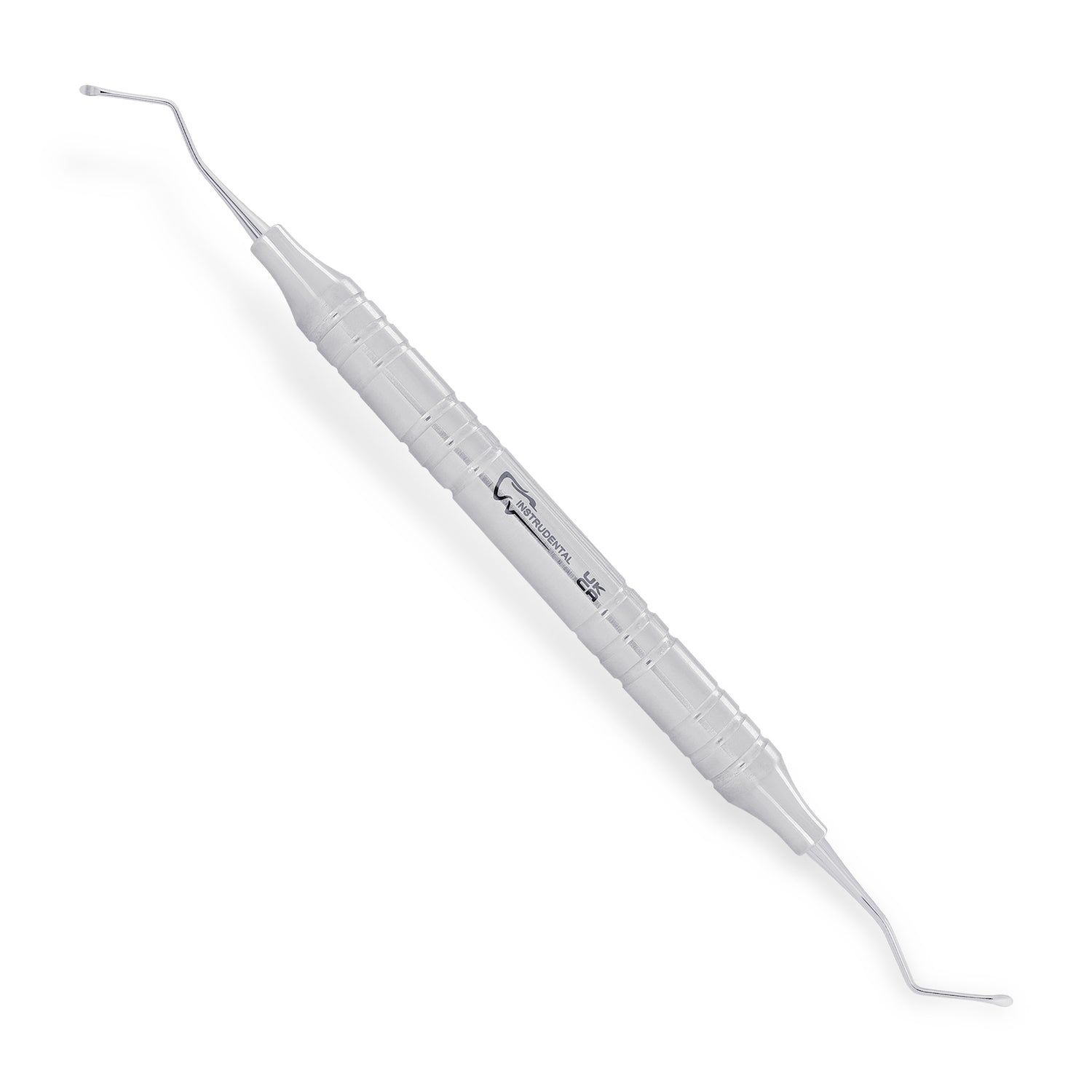
The right-curved Warwick James elevator, 2.5mm. Its small curved blade is worked into the periodontal space to luxate a root or fragment, and the right curve reaches surfaces a straight elevator cannot approach cleanly. Many clinicians keep the straight, left and right patterns as a working trio.
- Right-curved 2.5mm blade for approaches a straight elevator cannot reach
- Luxates roots and fragments before forceps application
- Small blade suits confined sockets and retained roots
- AISI 304 stainless handle with hardened Japanese-standard J2 working end
FAQs
What is a Warwick James elevator used for?
It luxates and elevates roots and root fragments during extraction, working into the periodontal ligament space to loosen the root before forceps are applied.
Why are there straight, left and right versions?
The three curves let you approach a socket from whichever side gives the best angle. Many clinicians keep all three, using the straight for direct access and the left and right for surfaces the straight cannot reach.
What material is this instrument made from?
The handle is corrosion-resistant AISI 304 stainless steel and the working end is hardened Japanese-standard J2 stainless steel, each chosen for its job: rust-resistant handling and a hard working end that keeps its shape through repeated autoclave cycles.
Part of our elevator range alongside the Warwick James straight and left patterns, Coupland, Cryer and Flohr elevators.
Browse our full Surgery range.
Manufactured by InstruDental, UK specialists in dental hand instruments.
Recently viewed