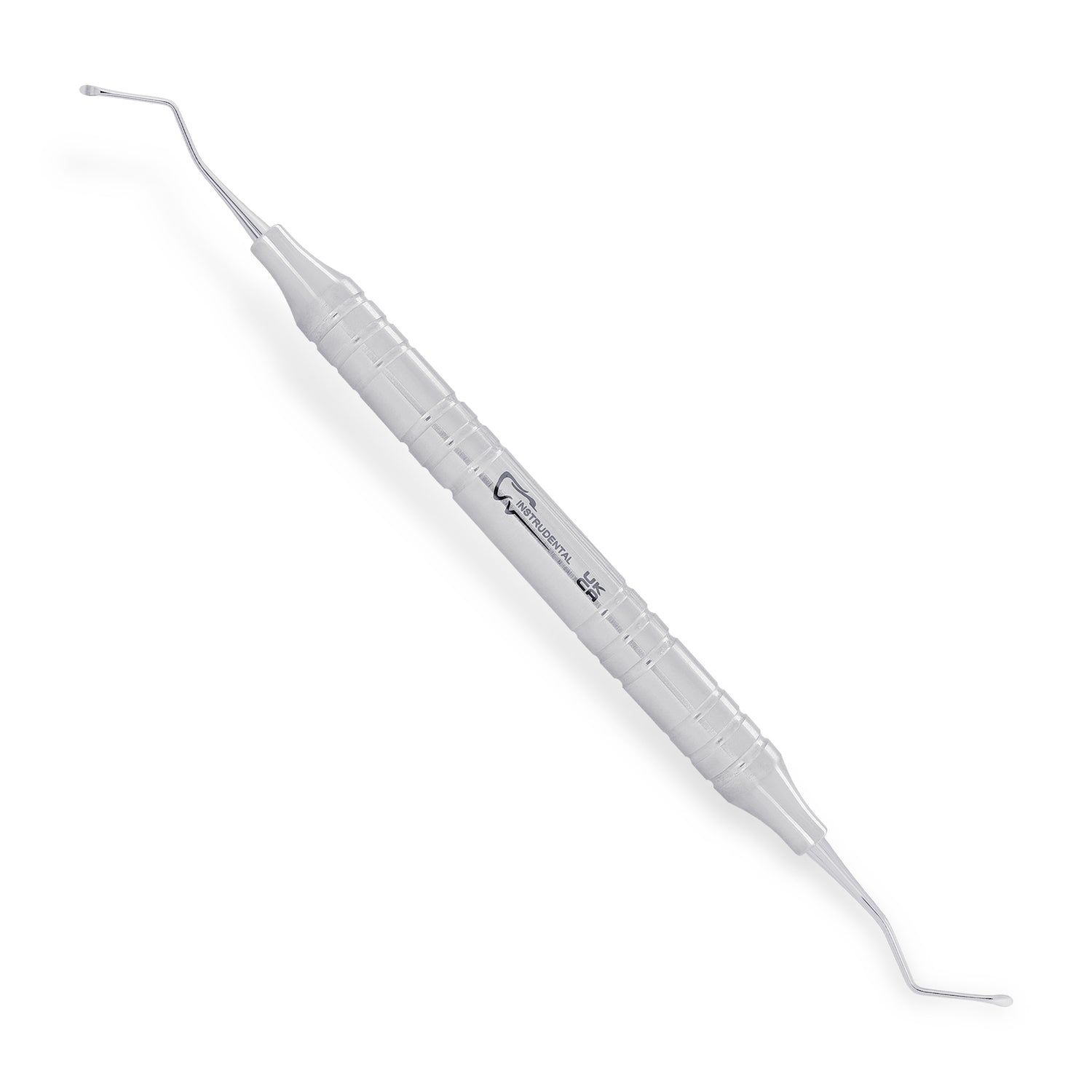
A straight periotome, also called a luxating elevator, with a 2.0mm blade, the narrowest of our single-width blades. The slim blade is worked down into the periodontal ligament space between root and bone to sever the ligament fibres, loosening the tooth before forceps are applied. Its small width suits narrow roots and tight spaces between teeth, and it can be taken further towards the apex where a wider blade would not sit. Cutting within the ligament space, rather than levering against bone, is the approach used when the socket walls are to be kept, for example before an implant.
- 2.0mm straight blade for narrow roots, apical work and tight interproximal spaces
- Straight shank for direct, in-line access, most at home in the front of the mouth
- Thin, sharp blade designed to cut the periodontal ligament rather than prise the tooth
- Japanese-standard J2 stainless steel working tip
- PPU handle; sold individually
FAQs
When would I choose the 2.0mm straight periotome?
When the root is slim or the space around it is tight, such as between crowded teeth, or when working deeper towards the apex. Wider 3.0mm and 5.0mm blades are better matched to broader roots.
Can it be used to lever the tooth out?
No. A 2.0mm blade is fine and is meant for cutting the ligament with gentle pressure along the root. Using it as a lever or twisting it can damage the tip. Use a root elevator for elevating once the tooth is loose.
What is the periotome made from?
The working tip is Japanese-standard J2 stainless steel, fitted to a PPU handle.
Also available as a 7-piece set: Periotome Luxating Elevator Set.
Part of our extraction range alongside periotomes, root elevators and extraction forceps.
Browse our full Surgery range.
Manufactured by InstruDental, UK specialists in dental hand instruments.
Recently viewed