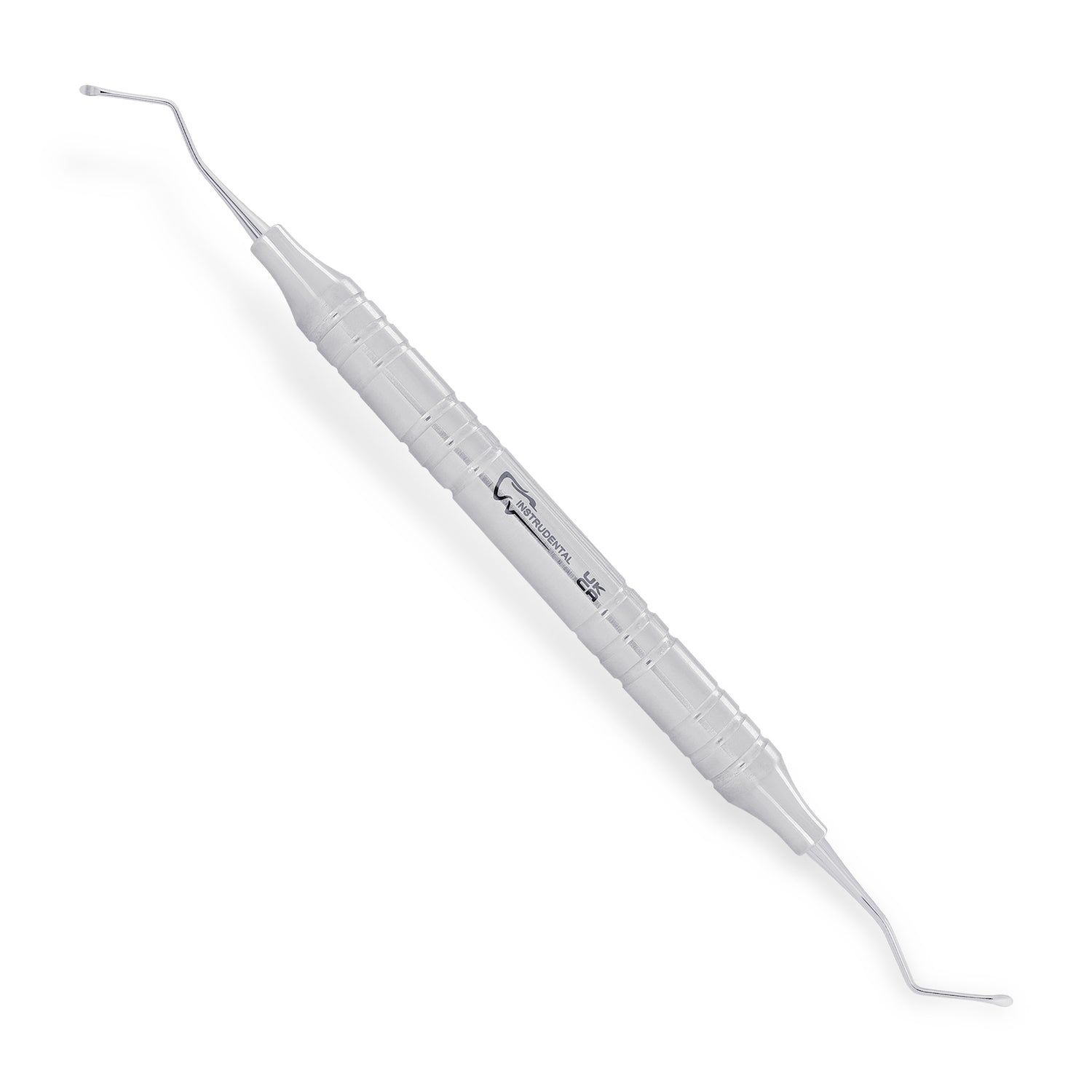


Amalgam Carver Hollenback 3
Couldn't load pickup availability
| SKU | 121916 |
| Brand | InstruDental |
| Type | Restorative |
| Category | Carvers & hatchets |
| Tags | 1219-16 |
| Stock | ✓ In Stock |
DETAILS AND CARE
The Hollenback 3 carver. Its fine, angled blades reach into the interproximal region and along the gingival margin, which is where excess amalgam is hardest to remove and most likely to cause problems if left.
- Fine, angled blades for interproximal and marginal carving
- Hollenback 3 pattern for margin refinement
- Double-ended for efficient carving without instrument changes
- AISI 304 stainless steel, fully autoclavable
FAQs
How does a Hollenback differ from a Ward carver?
A Ward has broader leaf-shaped blades for occlusal anatomy. A Hollenback is finer and angled, made for margins and interproximal areas. Many operators keep both on the tray.
When should carving be done?
While the amalgam is still carvable but firm enough to hold shape. Carving too early tears the surface; too late and the material resists the blade and the margins suffer.
What material is this instrument made from?
AISI 304 stainless steel, and it withstands repeated autoclave sterilisation.
Part of our restorative range alongside pluggers, condensers, burnishers and filling instruments.
Browse our full Restorative range.
Manufactured by InstruDental, UK specialists in dental hand instruments.


The Hollenback 3 carver. Its fine, angled blades reach into the interproximal region and along the gingival margin, which is where excess amalgam is hardest to remove and most likely to cause problems if left.
- Fine, angled blades for interproximal and marginal carving
- Hollenback 3 pattern for margin refinement
- Double-ended for efficient carving without instrument changes
- AISI 304 stainless steel, fully autoclavable
FAQs
How does a Hollenback differ from a Ward carver?
A Ward has broader leaf-shaped blades for occlusal anatomy. A Hollenback is finer and angled, made for margins and interproximal areas. Many operators keep both on the tray.
When should carving be done?
While the amalgam is still carvable but firm enough to hold shape. Carving too early tears the surface; too late and the material resists the blade and the margins suffer.
What material is this instrument made from?
AISI 304 stainless steel, and it withstands repeated autoclave sterilisation.
Part of our restorative range alongside pluggers, condensers, burnishers and filling instruments.
Browse our full Restorative range.
Manufactured by InstruDental, UK specialists in dental hand instruments.
Recently viewed